
Which System Is the Most Efficient for Mobile Refrigerated Containers?
Energy Consumption and Carbon Emissions: A Comparison of 5 Different System Configurations
Which System Is the Most Efficient for Mobile Refrigerated Containers?
Energy Consumption and Carbon Emissions: A Comparison of 5 Different System Configurations
by Dr. Serap OĞUZ TANATAR published July 28, 2025
Mobile refrigerated containers used in cold chain logistics play a critical role in ensuring the safety of pharmaceuticals, food, and biological products. However, these systems must also be evaluated and optimized in terms of energy efficiency and carbon footprint. The growing demand for mobile cold chain logistics, especially for temperature-sensitive products requiring deep-freeze conditions, necessitates innovative and sustainable cooling solutions. While conventional diesel-powered units are robust, they significantly increase greenhouse gas emissions and operational costs. With rising energy prices and global sustainability targets, the choice of power architecture for cooling systems has become a much more strategic decision. When selecting the appropriate system, it is essential to consider not only the initial investment cost but also operational energy efficiency and carbon emissions.
In this study, we present a comparison of energy consumption and carbon emissions across five different cooling system configurations for a 10 m³ mobile container designed to maintain temperatures between -20°C and -30°C. Which system is more efficient? Which configuration is more environmentally friendly? We examine all aspects in detail.
System Configurations Examined
- Diesel Engine Driven
- Inverter-Based AC Motor with Battery Support
- DC Motor (Non-Inverter) with Battery Support
- Inverter-Based AC Motor + Battery + Solar Power Support
- DC Motor (Non-Inverter) + Battery + Solar Power Support
These five systems were compared in terms of energy conversion efficiency, battery performance, motor type, and solar energy integration.
Calculations were based on summer conditions, with daytime temperatures of 35°C and nighttime temperatures of 20°C.
A fixed 20 kWh Li-ion battery capacity was considered for all relevant electric and hybrid scenarios. The combined average charge/discharge efficiency of the Li-ion battery was assumed to be approximately 90% (Battery University, n.d.). Solar energy integration was evaluated under the constraint that, due to the limited roof area of the mobile container (3.5 m x 2.1 m), only a small number of panels could be installed. It was anticipated that even the maximum achievable panel voltage would remain below the MPPT threshold voltage, and therefore PWM (Pulse Width Modulation) charge controllers would be used. Constraints specific to mobile systems, such as shading and dynamic variations in solar angles during travel, were also taken into account.
Scenario 1: Diesel Engine-Driven Cooling
In this configuration, the diesel engine converts the chemical energy in the fuel into mechanical work to drive the refrigeration compressor. The compressor is directly powered by the diesel engine. This system operates independently of the electrical grid and does not utilize battery storage for cooling operations.
For the mobile container application, a thermal efficiency of 30% has been assumed (Lira, n.d.).
Scenario 2: Inverter-Driven AC Motor with Battery-Supported Cooling
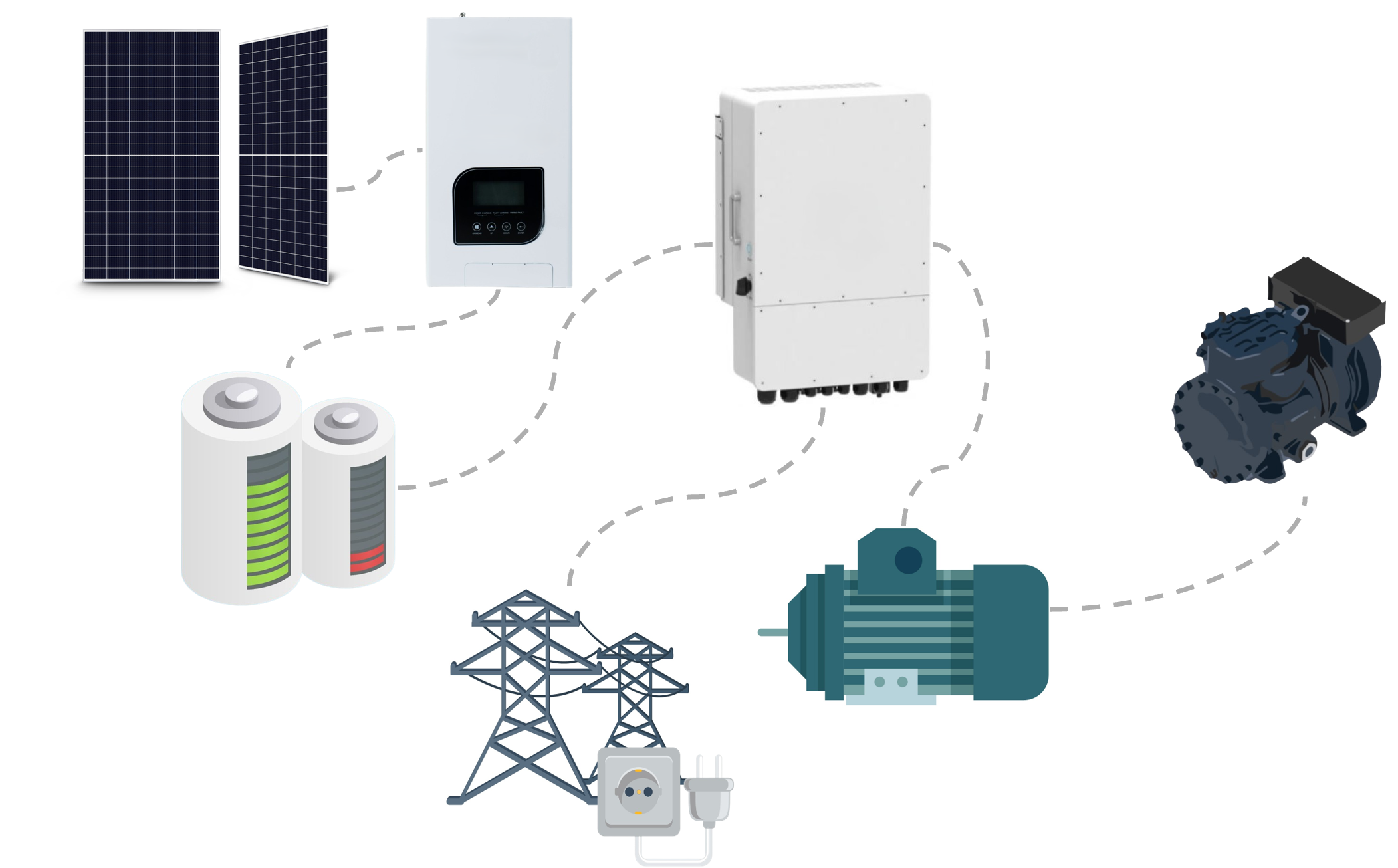
In AC motor scenarios (Scenario 2 and 4), a variable frequency drive (inverter) is used to control the compressor speed. The refrigeration compressor is driven by an AC motor controlled by the inverter. The primary power source is the electrical grid, while the 20 kWh Li-ion battery provides backup power.
Physical tests have shown that inverter losses typically range between 15% and 20% in real-world conditions; thus, inverter efficiency is considered as 82.5%. AC motor efficiency is assumed to be 92%. The combined efficiency of the inverter-driven AC motor is calculated as 75.9% (Danfoss, n.d.; Rigid HVAC, n.d.).
Scenario 3: Non-Inverter DC Motor with Battery-Supported Cooling
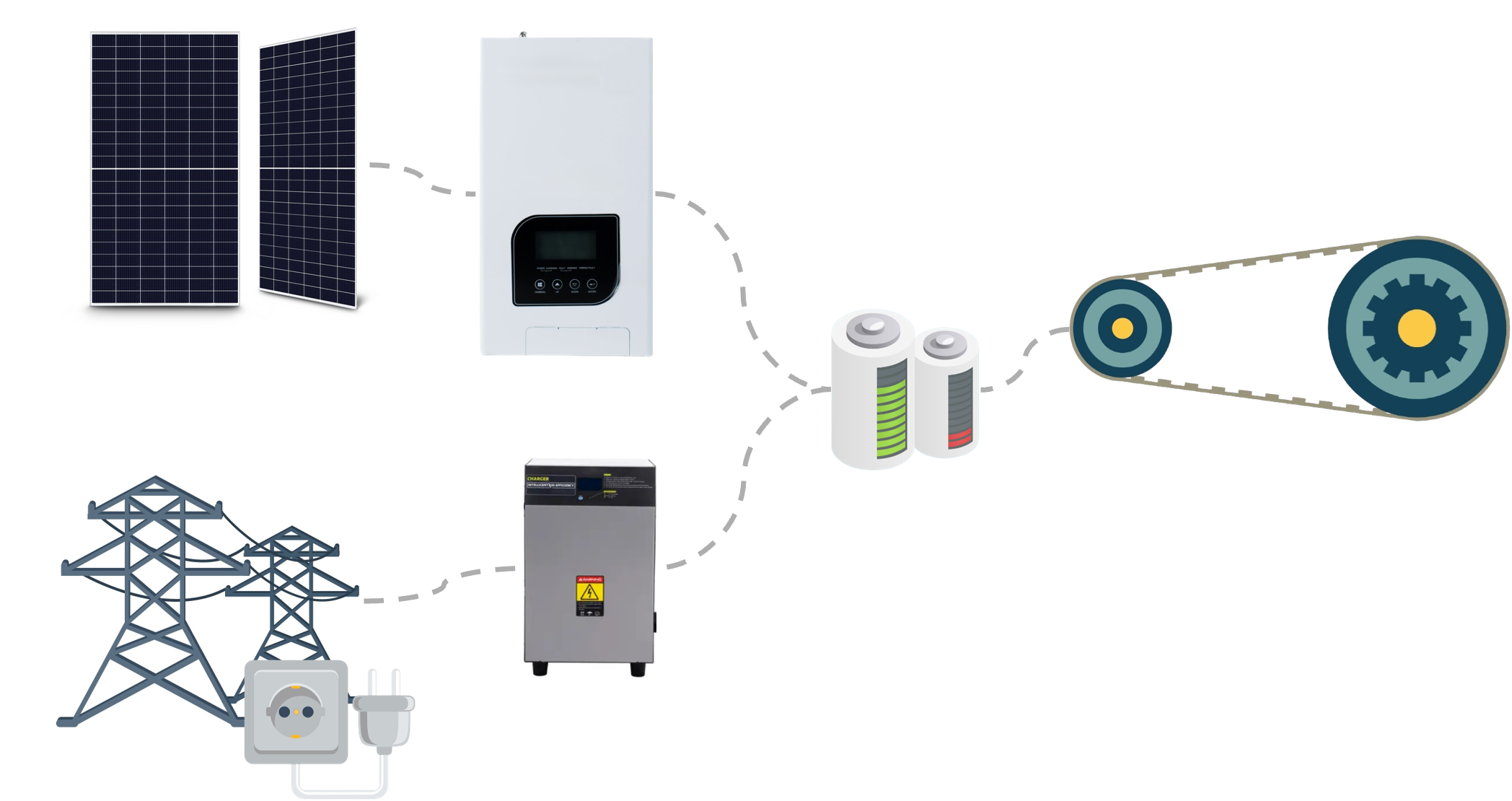
In DC motor scenarios (Scenario 3 and 5), brushless DC (BLDC) motors are used, known for their high efficiency. The refrigeration compressor is directly powered by a DC motor. The system is supplied by the electrical grid (via an AC-DC converter) or a 20 kWh Li-ion battery as the primary power sources. No inverter is used in this system, which minimizes conversion losses—especially when powered by DC sources like batteries or solar panels. When connected to an AC grid, an AC-DC rectifier is required, which introduces some conversion losses.
The efficiency of the BLDC motor is assumed to be 95% (Reddit, n.d.; Rigid HVAC, n.d.).
Scenario 4: AC Motor with Battery and Solar Power-Supported Cooling
This hybrid configuration combines the core features of Scenario 2 (inverter-driven AC motor and 20 kWh Li-ion battery) with solar power generation. Solar panels are mounted on the roof of the container and help reduce dependence on the electrical grid by either charging the battery or directly supplying power to the cooling system.
Scenario 5: DC Motor with Battery and Solar Power-Supported Cooling
This hybrid configuration combines the core features of Scenario 3 (DC motor and 20 kWh Li-ion battery) with solar power generation. The solar panels can either directly power the DC motor or charge the battery, enabling high efficiency with minimal energy conversion steps.
Conclusion
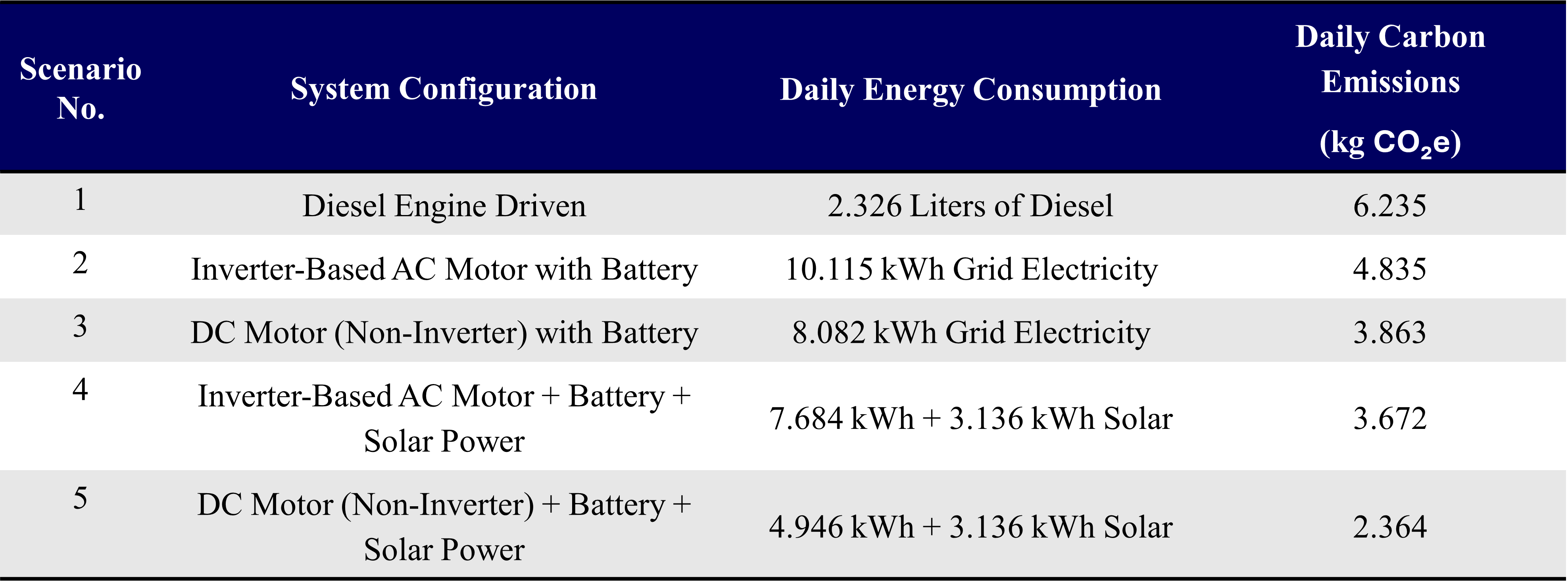
Based on the calculations and assumptions made, the daily energy consumption and carbon footprint of each scenario are summarized in the table below:
High Environmental Burden of Diesel Systems
Scenario 1 (diesel-driven) has the highest carbon emissions. Diesel engines also produce local air pollutants beyond CO2, such as NOx, PM, and SOx, creating a broader environmental and health burden. This indicates that diesel systems are the least preferred option from a sustainability perspective.
Efficiency Advantages of Electric Systems
Systems powered by grid electricity (Scenario 2 and Scenario 3) exhibit lower carbon emissions compared to diesel systems. Especially the DC motor system (Scenario 3) is more efficient than the AC motor system (Scenario 2) due to reduced energy conversion losses enabled by direct operation without an inverter. Although inverter-driven AC motors have their own conversion losses, their variable speed capabilities significantly improve overall system efficiency, resulting in energy savings.
Role of Solar Energy in Reducing Carbon Footprint
Solar energy integration (Scenario 4 and Scenario 5) substantially reduces carbon emissions by lowering grid electricity consumption. The lowest carbon emissions were observed in the solar-powered DC motor system (Scenario 5). This highlights the critical role of renewable energy in enhancing environmental performance for mobile refrigeration.
Challenges of Mobile Solar Integration
The limited roof area of the container restricts the number of solar panels that can be installed. Additionally, due to panel voltage remaining below the MPPT threshold, the use of PWM charge controllers causes significant efficiency losses ranging between 5% and 30% in solar energy harvesting (DIY Solar Forum, n.d.; Morningstar Corp., n.d.; Solar 4 RVs, n.d.). Factors specific to mobile containers, such as shading, dynamic changes in solar angles during transit, further degrade the practical performance of solar panels. Therefore, a substantial amount of supplementary energy from the grid or battery is still required.
Importance of Battery Systems
The 20 kWh Li-ion battery serves as a critical buffer in all electric scenarios. The battery's high charge/discharge efficiency is assumed to be 90%. LiFePO4 batteries can achieve 95-98% efficiency at 0.5 C charge/discharge rates (Battery University, n.d.), providing an efficient solution for energy storage and distribution. The battery enhances system reliability by ensuring continuous cooling during periods of insufficient solar energy or grid outages.
The Most Efficient Configuration
Considering low carbon footprint and high energy efficiency, Scenario 5 (Non-Inverter DC Motor with Battery and Solar Power-Supported Cooling) stands out as the optimal choice. The compressor driven directly by a DC motor combined with solar energy integration minimizes energy consumption and environmental impact.
Recommendations
Environmentally Sustainable Approach
Transitioning from diesel-driven cooling systems to electric and hybrid solutions should be prioritized to reduce carbon emissions and local air pollution.
Optimization of Solar Energy Systems
To fully harness solar potential in mobile containers, panels with higher Vmp values should be preferred where possible. Solutions suitable for mobility, such as flexible or foldable panels, can also be considered.
Battery Management
Smart battery management systems (BMS) should be integrated to extend battery life and optimize system efficiency. These systems monitor charge/discharge rates and battery health to maximize performance. Selecting a charge/discharge rate at or below 1C will ensure high energy efficiency and prolong battery lifespan (NenPower, 2025).
Reducing Heat Load
Maintaining and improving the insulation quality of the container will directly reduce cooling loads across all scenarios. Considering that solar radiation adds extra heat load on exterior surfaces in mobile applications, additional measures such as reflective coatings or passive cooling strategies should also be evaluated.
References
Battery University. (n.d.). BU-808c: Coulombic and energy efficiency with the battery.
Danfoss. (n.d.). Inverter compressor technology offers new opportunities for air conditioning systems.
DIY Solar Forum. (n.d.). MPPT input voltage vs. efficiency.
Ember. (2025). Türkiye Electricity Review 2025.
Food and Agriculture Organization of the United Nations. (n.d.). Heat gain calculation refrigerated container.
Lira, C. T. (n.d.). The Diesel Engine. Michigan State University.
Morningstar Corp. (n.d.). What are the different types of solar charge controllers?
NenPower (2025). How can charge and discharge rates affect the performance of energy storage systems
Rigid HVAC. (n.d.). Discover differences AC compressor DC compressor smallest options compared.
Rigid HVAC. (n.d.). Efficiency inverter compressor refrigerator.
Rigid HVAC. (n.d.). Inverter technology refrigerators advantages.
Solar 4 RVs. (n.d.). Choosing the right solar charge controller regulator.
T.C. Enerji ve Tabii Kaynaklar Bakanlığı. (2024). Türkiye Elektrik Üretimi ve Elektrik Tüketim Noktası Emisyon Faktörleri.
